We add vision AI to the cameras you already have — via ONVIF/RTSP, no rewiring, no swapping your recorder. A box at the edge, next to your NVR, turns that video into a verified alarm: it only alerts when it matters, with no mandatory cloud.
How it integrates
The pattern is bring your own camera: an edge box on your LAN ingests the ONVIF/RTSP streams your CCTV already emits, runs the AI locally and returns events — without touching your cameras or your recorder. It's the 2026 industry baseline, not a trick.
Any standard IP camera. We take the ONVIF/RTSP stream they already generate — no rewiring.
An edge box on your network ingests the streams and runs detection and the verified alarm locally.
Clip + event via webhook/MQTT to your VMS, monitoring center or phone. The video never leaves the premises.
ONVIF/RTSP is the open standard most cameras and VMS speak today — the 2026 baseline, not an exclusive differentiator. What changes is what we do with that stream.
What it detects
Most CCTV alarms are false. Our AI only fires when a person or vehicle meets a deterministic spatial rule — auditable and adjustable by you, not a black box.
Alerts when someone stays inside a restricted zone we define together — not because a leaf blows by or a shadow crosses.
restricted zonetime thresholdA virtual line over the entrance, perimeter or conveyor: detects the crossing and its direction (in / out). Ideal for doors, gates and corridors.
crossing directionperimeterA person who lingers or hangs around a zone beyond the expected time — the pattern that precedes most incidents. Scalable to early warning.
time in zoneearly warningDistinguishes and counts person vs. vehicle, with an anonymous track-id (never biometrics or facial recognition — privacy by design). The basis for flow and occupancy reports.
person / vehicleanonymous track-idEvery trigger is an explainable geometric rule (zone, line, time) — one you can review, adjust and audit. Not an unverifiable promise of an “X% reduction.”
See it working
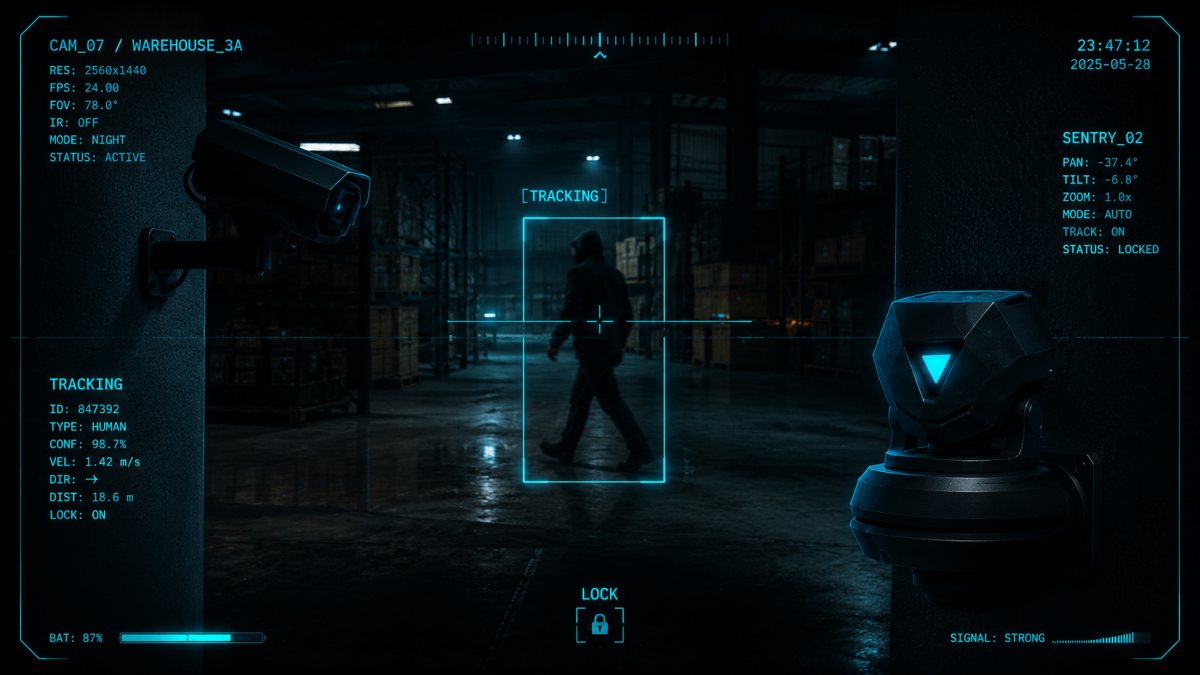
This isn't a mockup: it's our edge AI running on real footage. The red box marks the intruder inside the zone (alarm); the cyan box marks what's ignored.
Red box: a person inside the restricted zone — triggers the verified alarm and saves the clip.
Cyan box: detected but out of rule — ignored. That's how false alarms die.
Tracking, line crossing and loitering running in real time, at the edge.
The free diagnostic
Before any quote, we run a no-commitment survey of your camera fleet. It almost always turns up out-of-focus, mispositioned or down cameras nobody was watching — and leaves you with a clear map of which AI is feasible on each one.
ONVIF discovery of the fleet: model, firmware, codec, resolution, FOV and position of each camera, and which ones are out of service.
For each camera: which analytics are viable today, which need repositioning or adjustment, and which aren't suitable. No fluff.
We run the verified alarm on your RTSP or a clip of yours and hand you the annotated video + a CSV of events.
| Camera | Location | Status | Feasible analytics |
|---|---|---|---|
| CAM-01 | Main entrance | SUITABLE | Line crossing + person/vehicle counting |
| CAM-04 | East perimeter | SUITABLE | Zone dwell + loitering |
| CAM-07 | Back warehouse | ADJUST | Reposition / raise sub-stream resolution |
| CAM-09 | Parking lot | OUT OF SERVICE | No signal — needs repair before AI |
Illustrative example of the deliverable. The real table comes from your own fleet, during the survey.
Where it applies
Loitering after closing hours, line crossing at entrances and flow counting — verified alarms so the alert arrives when someone's there, not when a car drives by on the street.
Restricted zones at docks and aisles, unauthorized dwell after shift, and vehicle counting in the loading yard. Events to your monitoring center, without the video leaving the premises.
Tripwire on the fence line and dwell in restricted strips. Early warning from loitering before the intrusion — over the perimeter cameras you already have.
Person/vehicle counting and classification, line crossing at barriers and dwell in spaces or ramps. Occupancy data without installing new sensors.
Why us
Connecting AI over ONVIF/RTSP is something almost the whole market does in 2026 — including local competitors like USS in Argentina. What sets us apart is how we do it.
We're honest about the starting point: standard security cameras work for these rules; everything else is assessed camera by camera in the diagnostic. Deterrence, where it applies, is signage only — never a weapon.
Frequently asked questions
No. We connect to the ONVIF/RTSP stream your cameras already emit and run the AI on an edge box next to your NVR. Your CCTV and your VMS keep working the same way; we just add the analytics layer on top.
It's not mandatory. Detection and the verified alarm run at the edge, inside your premises. What leaves the site are the events (and the clip if you want it), via webhook or MQTT to your monitoring center or phone.
No. We work with an anonymous track-id and spatial rules (zone, line, time). We don't do biometrics or person identification — in line with data protection law.
It works with standard IP cameras that speak ONVIF/RTSP, which is most of them. Even so, we don't promise blindly: the free diagnostic tells you camera by camera which analytics are feasible, which need adjusting and which aren't suitable.
The diagnostic comes first, with no commitment. Only after seeing your real fleet and running a demo on your own video does it make sense to talk scope. Start by requesting the free survey.
Start with no commitment
Tell us what cameras you have (brand, quantity, location) and we'll coordinate the survey + a demo of the verified alarm on your own video. No price until we see what's there.
We reply within 48 h. No commitment · no mandatory cloud · data on your site.